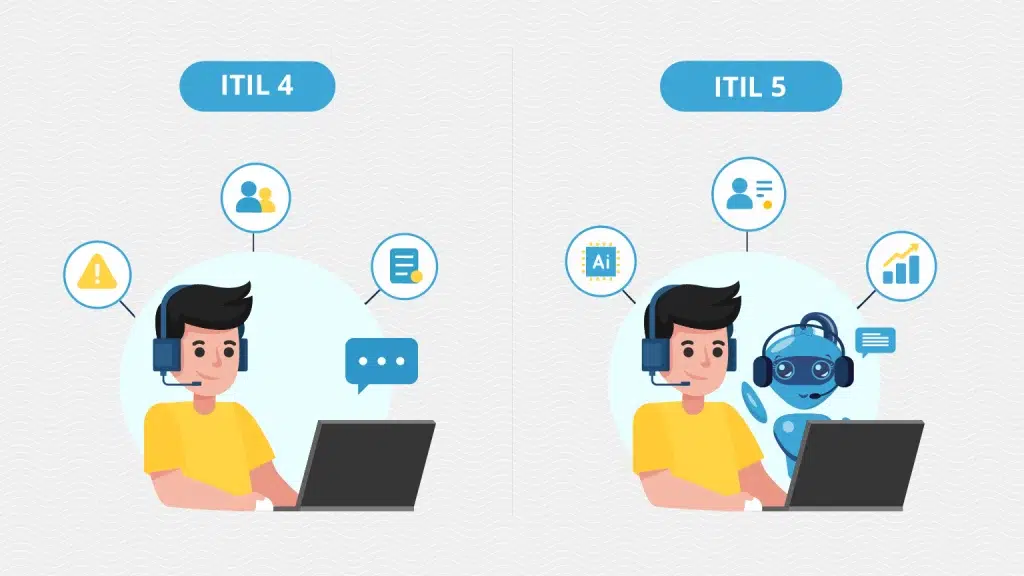
The service desk has always been the human face of IT support — the place where users go when something breaks, when they need access to something new, or when they just don’t know who else to ask. ITIL 4 built a strong, human-centred model for that role. ITIL Version 5 doesn’t throw that model out — it extends it, layering AI, context, and proactive insight on top of the same practice.
Here’s a breakdown of how the two compare.
ITIL 4 Service Desk: Human-Centred Support
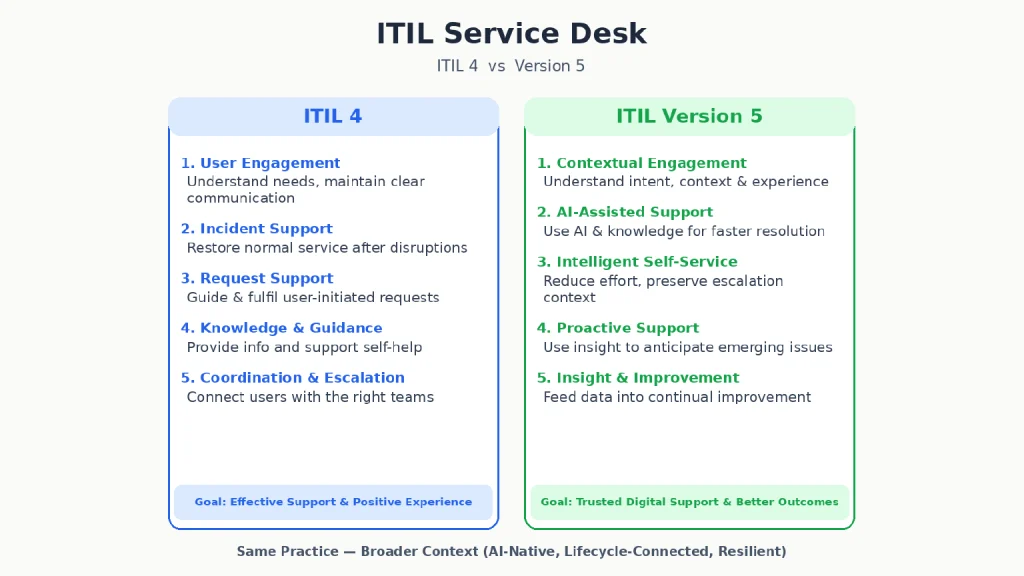
ITIL 4 frames the service desk around one core idea: human-centred support, communication, and effective issue resolution. It’s built on five key activities:
- User Engagement — Understand user needs and maintain clear, ongoing communication.
- Incident Support — Help restore normal service quickly after disruptions.
- Request Support — Guide and fulfil user-initiated service requests.
- Knowledge & Guidance — Offer useful information and support self-help.
- Coordination & Escalation — Connect users with the right teams and expertise when needed.
The goal is straightforward: effective user support and a positive service experience. It’s a model built on communication, empathy, and getting people unblocked.
ITIL Version 5 Service Desk: AI-Enhanced Support
ITIL Version 5 keeps that same human-centred foundation but adds a layer of intelligence and foresight. The focus shifts to human-centred support enhanced by AI, experience, and context. Its five key activities mirror ITIL 4’s structure, but each one is upgraded:
- Contextual Engagement — Understand not just the request, but the user’s intent, context, and overall service experience.
- AI-Assisted Support — Use AI and knowledge systems to speed up resolution.
- Intelligent Self-Service — Reduce user effort while preserving escalation context, so nothing gets lost if a case needs to be handed off.
- Proactive Support — Use operational insight to catch emerging issues before they escalate.
- Insight & Improvement — Feed user and service data back into continual improvement.
The goal here is broader: trusted digital support and better service outcomes — not just resolving the ticket in front of you, but improving the system as a whole.
The Evolution: Same Practice, Broader Context
What’s most interesting isn’t that ITIL Version 5 replaces ITIL 4 — it’s that it evolves it. The core DNA carries forward:
| In ITIL 4 | In Version 5 |
| Human-centred | AI-native context |
| Value co-creation | Lifecycle-connected |
| Practice-integrated | Experience + resilience |
In short: it’s the same practice, applied with a broader context. ITIL 4 taught service desks to listen and resolve. ITIL Version 5 teaches them to anticipate, connect, and continuously learn — with AI as a force multiplier rather than a replacement for the human at the centre of it all.
Takeaway
If your service desk is still measured purely on ticket resolution time, ITIL 4’s model already gives you a solid foundation. But if you’re thinking about how AI, proactive monitoring, and contextual data can make support faster and smarter, ITIL Version 5 offers the roadmap — without asking you to abandon the human-centred principles that made the practice work in the first place.