
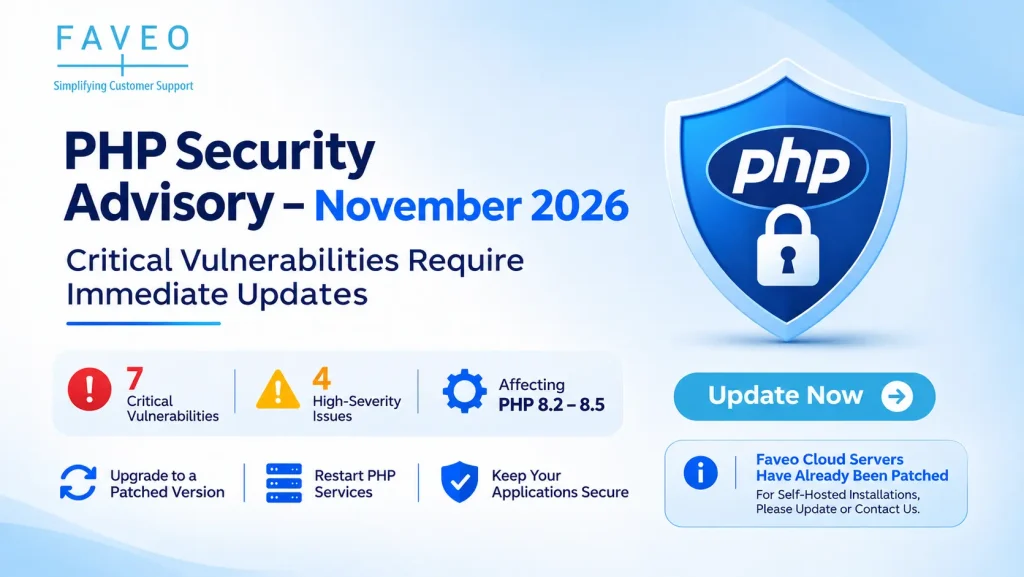
The PHP development team has released a series of important security updates addressing multiple vulnerabilities across supported PHP versions. The November 2026 security releases fix seven critical vulnerabilities, rated 9.2 under CVSS v4.0, along with four high-severity vulnerabilities.
Some of these vulnerabilities could potentially allow attackers to execute arbitrary code remotely, compromise application security, manipulate session data, or disrupt application availability.
Although several vulnerabilities require specific server configurations to exploit, some affect commonly used PHP configurations. Consequently, administrators should treat these updates as a priority and ensure that all their PHP environments are running patched versions.
Which PHP versions are affected?
The November 19, 2026 security releases address vulnerabilities across the following PHP versions.
| PHP Branch | Recommended patched version |
| PHP 8.5 | 8.5.13 |
| PHP 8.4 | 8.4.28 |
| PHP 8.3 | 8.3.37 |
| PHP 8.2 | 8.2.36 |
Administrators running older PHP versions should also review their package security updates.
For PHP 8.1 and earlier, the upstream PHP project no longer provides regular security releases. Some package maintainers have provided backported security fixes, but these should be treated as a temporary measure rather than a substitute for upgrading to a supported PHP branch.
Recommendation: Upgrade to a supported PHP version wherever possible. Do not assume that your installation is secure simply because your application continues to function normally.
Understanding the security vulnerabilities
The November security release addresses several categories of vulnerabilities.
1. Remote Code Execution (RCE)
Some of the critical vulnerabilities could potentially allow unauthenticated attackers to execute arbitrary code with the privileges of the PHP worker process.
This is particularly concerning for publicly accessible web applications, where successful exploitation could compromise application data and server resources.
2. PHP-FPM request smuggling
CVE-2026-129289 affects PHP-FPM and can potentially allow remote code execution under specific FastCGI connection-handling configurations.
3. Session handling vulnerabilities
Issues involving session file handling and session serialization could potentially allow attackers to manipulate session data and exploit vulnerable application components.
4. Memory management vulnerabilities
Several vulnerabilities involve use-after-free conditions and memory corruption. Depending on the configuration and circumstances, these could lead to application crashes or arbitrary code execution.
5. Additional high-severity vulnerabilities
The release also addresses issues involving:
- PHP-FPM privilege escalation.
- PHAR signature verification bypass.
- Improper handling of mixed-case HTTPS URL schemes.
- Denial of service through specially crafted HTTP headers.
The exact exploitability depends on the PHP version, server configuration and application implementation. Nevertheless, applying the security updates is the recommended course of action.
What should server administrators do?
If you manage PHP-based applications, websites or enterprise software, we recommend taking the following steps.
1. Identify your PHP versions
Check which PHP versions are installed on your servers, including PHP-FPM and command-line environments.
You can use:
`php -v`
Remember that this command only reports the CLI PHP version. Your web server may be running a different PHP-FPM version.
2. Upgrade PHP
Install the appropriate security release for your PHP branch:
- PHP 8.5 – 8.5.13 or later.
- PHP 8.4 – 8.4.28 or later.
- PHP 8.3 – 8.3.37 or later.
- PHP 8.2 – 8.2.36 or later.
If you are using a Linux distribution that maintains its own PHP packages, verify the package security status with your distribution before proceeding.
3. Restart PHP services and background processes
After upgrading PHP, ensure that PHP-FPM and other long-running PHP processes are restarted.
This includes application queue workers, scheduled processes and other background services that may continue using an older PHP runtime.
4. Verify the installation
Once the update is complete, check the installed PHP and package versions again. Confirm that all application environments are using the patched runtime.
5. Review your server configurations
Review PHP-FPM, FastCGI, session handling and other relevant server configurations. Security updates should be complemented by good server-hardening practices.
Faveo security update
At Faveo, security is an important part of our product development and infrastructure management practices.
Following the November 2026 PHP security advisories, all Faveo cloud servers have already been patched to address the reported vulnerabilities.
For organisations running Faveo Helpdesk or Faveo ServiceDesk on their own infrastructure (self-hosted installations), we strongly recommend checking the PHP version and applying the relevant security updates.
If you need assistance with the PHP upgrade or have questions about securing your Faveo installation, our technical team can help.
You can reach us at support@faveohelpdesk.com.
Final thoughts
Security vulnerabilities are an unavoidable part of maintaining modern software infrastructure. What matters is how quickly they are identified, addressed and communicated.
Keeping PHP, application dependencies, operating systems and server configurations updated is essential for protecting business applications and the data they manage.
We encourage all PHP administrators, hosting providers and organisations running PHP-based applications to review this advisory and prioritise the necessary updates.
Stay updated. Stay secure.
References and further reading:
- Official PHP Security Releases – November 2026
- PHP 8.5.13 Release Announcement
- Laravel Forge – PHP Security Advisory, November 2026
This advisory is intended to provide general security information. Administrators should verify the appropriate updates for their operating system, PHP distribution and deployment environment.